Viability
Is it worth building for the business?
- Engage stakeholders early
- Agree on goals and success metrics
- Create a roadmap for design
With founders, business and marketing
Most products don't fail because of bad screens. They fail because the business, the build and the people using it were never lined up. This is the framework I use to line them up first, then make the product something people love.
Good design is a team sport. Product wants speed, engineering wants clarity, business wants numbers and users just want it to work. Without a shared way of working, every review turns into a debate about taste.
Simple to Significant gives everyone the same map. It says what has to be true before we move on, who decides at each level and when it's time to polish. Teams stop arguing about opinions and start agreeing on evidence. I have used it to lead SaaS, fintech, healthcare and AI products for over two decades.
Before a single pixel is polished, an idea has to make sense for the business, be possible to build and be easy for people to use. Miss one and the product struggles, no matter how good it looks.
Is it worth building for the business?
With founders, business and marketing
Can we build it well, on time?
With product and engineering
Will people get it, and keep using it?
With users, design and research
The simple part, and the part most teams rush. Everyone agrees on what we're building, why and for whom. Nothing moves up until all three hold.
All stakeholdersThe product works the same way every time. Patterns, a design system, edge cases and performance. This is where trust is earned.
Small core teamThe details that make people smile and recommend you. Delight only works on a stable base. On a shaky one, it's just decoration.
Small core teamThe lenses and levels play out across six stages. Launch isn't the finish line. Feedback from production flows straight back into the next round of improvements.
Start aligned.
Find the real problem.
Design the solution.
Make it better.
Build it right.
Learn from real use.
What we learn in production goes straight back into iteration. The product keeps getting better after launch, not just before it.
Product, engineering, business and marketing stay involved at every stage, so there are no surprises at handover.
A framework only works if the effort behind it is balanced. Too much time in meetings and the craft slips. Too much time in pixels and the product drifts from the business. So I split it.
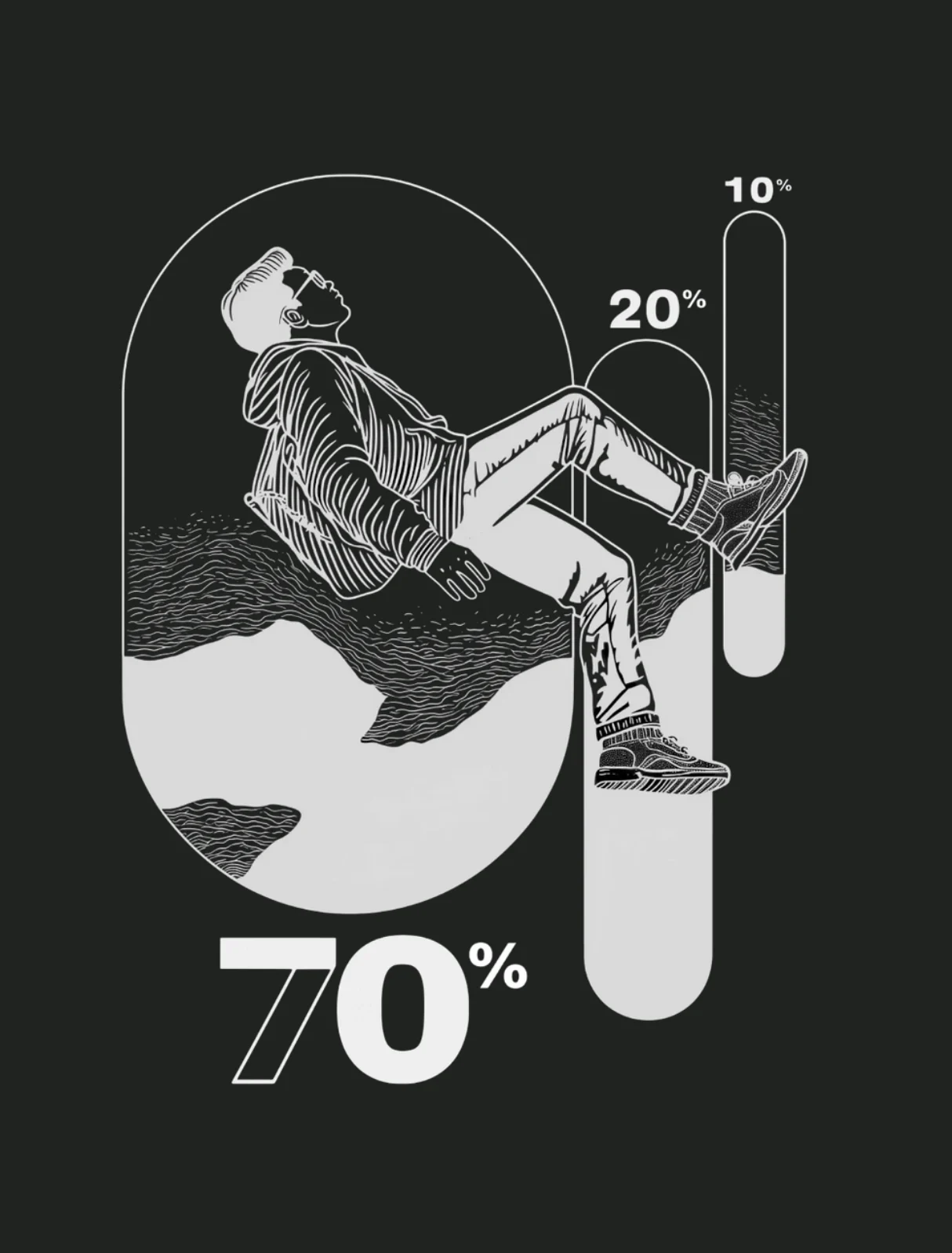
Research, design and prototyping on the one thing that moves the product most. This is where the baseline gets built and the real work happens.
Working with founders, product and engineering on goals, scope and trade offs, so every design decision stays tied to a number that matters.
Coaching the team, raising the bar on craft and exploring new ideas, from AI tools to the next big bet.
At MobiKwik, research showed people couldn't find services and dropped off mid payment. I brought product, engineering, business and marketing together around one goal, put every service on the home page and added room for new features like UPI and hotel booking.
AI makes the baseline matter even more. A model has to be worth what it costs, reliable enough to build on and clear enough that people trust its answers.
AI also speeds up the framework itself. In discovery and implementation I write structured specs that AI build tools turn into working prototypes, with the design system keeping every screen consistent. At Saronil Health, that's how 15+ hospital modules went from spec to working product.
How I design with AIIt is the product design framework I use to take a product from a brief to production. Every decision first has to pass three tests: is it viable for the business, feasible to build and usable for real people. Once that baseline is solid, a smaller team works on stability and then delight, the parts that make a product significant.
Design thinking is great at finding the right problem. Simple to Significant adds what happens after: who needs to be in the room at each level, what gets built first, and how the product keeps improving after launch through a loop between production and iteration.
Only after the product is viable, feasible, usable and stable. Delight on top of a shaky foundation looks good in a demo and fails in daily use. Delight on top of a stable product is what makes people recommend it.
All stakeholders shape the baseline: product, engineering, business, marketing and users. Stability and delight are handled by a small core team of design, product and engineering, so decisions stay fast and the craft stays high.
Yes. AI raises the stakes on all three baseline tests: the model has to be worth its cost, reliable enough to build on, and clear enough that people trust it. I also use AI inside the process, turning structured specs into working prototypes during discovery and implementation.
It is how I split my time and my team's effort. 70% goes to hands on work on the top priority, the research and design that moves the product. 20% goes to business and product alignment, so the work stays tied to real goals. 10% goes to leadership and new ideas. It keeps the craft high without losing sight of the business.
Across SaaS, fintech and healthcare products, including the MobiKwik redesign, where it led to 42% better service discoverability, 25% fewer transaction drop offs and 60% growth in UPI adoption within 45 days.
Whether you're hiring a head of design or need a product moved from idea to launch, let's talk.
Fix UX friction, design AI that users trust, unlock up to 5x growth. Get a free UX assessment.